
The Science of the Savannah: Why the Mara’s Hidden Ecological Marvels Justify the Premium
For the elite traveler, the true allure of the Masai Mara is often masked by its own fame. We have all seen the classic nature documentaries showcasing millions of wildebeest crossing treacherous rivers. But when confronting the luxury price tags of premier camps like Mahali Mzuri, a discerning traveler must ask: What lies beneath the surface spectacle? What makes this specific geographic pocket worth a premium over any other wilderness on earth?
The answer does not lie in the physical thread-counts of your canvas tent or the vintage of the champagne in your cooler. The true value proposition is the unmatched access to a living, breathing laboratory of evolutionary marvels and ancient animal psychology. In this master ecological brief, we explore the jaw-dropping scientific facts, hidden wildlife behaviors, and unique geographical phenomena that make the Masai Mara a priceless investment for the curious mind.
1. The Serengeti-Mara Ecosystem: The Planet’s Last Great Biological Engine
To understand why this land is so fiercely protected—and why accessing it costs a premium—one must understand the sheer physics of its geography. The Mara is not just a park; it is the critical northern terminus of a massive, 12,000-square-mile evolutionary machine.
The Thermal Updraft Catalyst
The Masai Mara sits at a unique ecological crossroads where the sub-humid Kenyan highlands meet the semi-arid Tanzanian plains. This creates a distinct microclimate dominated by powerful thermal updrafts. These invisible wind currents lift vast moisture reserves from Lake Victoria, dumping highly localized, nutrient-dense rains across the Mara.
The Volcanic Soil Premium
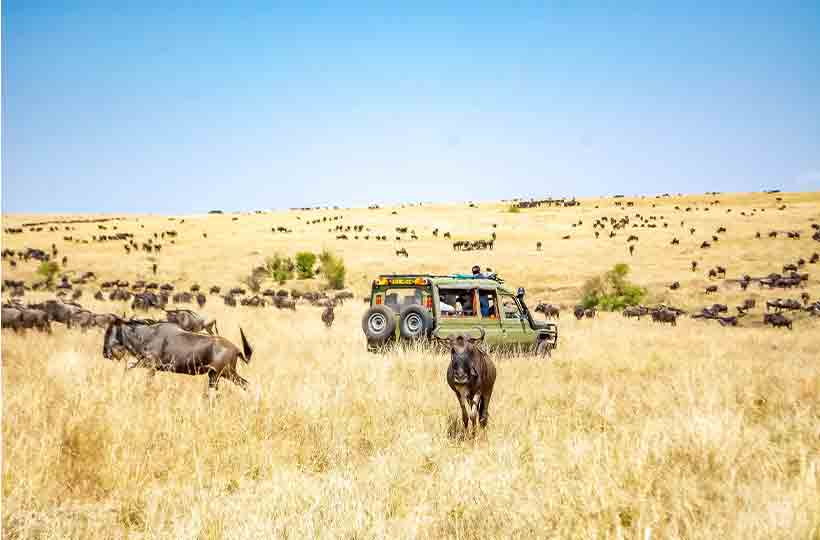
Because the Mara’s grasses grow on ancient volcanic ash layers from the Great Rift Valley, the soil contains hyper-concentrated levels of phosphorus, nitrogen, and calcium. For migratory herbivores, eating a single blade of Mara grass is the nutritional equivalent of a multi-vitamin. This unique soil chemistry is the biological reason why 1.5 million wildebeest are compressed into this exact space every year—they are chasing the most nutritious food source on the planet.
2. Animal Intelligence: Witnessing the Mara’s Hidden Cognitive Feats
When you invest in a luxury safari within a private conservancy, you are funding the ability to quietly sit and observe complex animal behavior without the disruptive engine noise of mass public tourism. This isolation reveals incredible displays of animal intelligence.
The Sophisticated Strategy of the Five Musketeers
The Mara is home to one of the most famous and anomalous wildlife phenomena in history: “Tano Bora” or the Five Musketeers. Typically, male cheetahs are solitary creatures or live in pairs. However, the unique predator density of the Mara forced a group of five unrelated male cheetahs to form a massive, unprecedented super-coalition.
By working together, this single group rewrote the biological textbooks. They successfully hunted prey three times their size—including massive elands and adult topis—exhibiting pack tactics previously thought to be exclusive to lions and wolves.
Elephant Communication and the Subsonic Network
The family herds moving through the Motorogi Conservancy are engaged in a constant, invisible conversation. Elephants utilize infrasound—low-frequency rumbles that register below the human range of hearing.
These sound waves travel through the earth’s surface for up to six miles. Other herds pick up these seismic vibrations through the sensitive nerve endings in their feet, allowing them to coordinate group movements, avoid conflict, and locate hidden water holes across vast distances.
3. The Unseen Micro-World: The Unsung Heroes of the Savannah
While luxury travelers flock to the Mara to spot the Big Five, your expert local guides will introduce you to the micro-ecosystem that keeps the entire savannah alive. Without these hidden actors, the great migration would collapse within a matter of weeks.
The Dung Beetle’s Astrological Navigation
The humble dung beetle is the primary sanitation engineer of the plains. Millions of migratory animals drop thousands of tons of waste daily. The dung beetle buries this waste, recycling vital nitrogen directly back into the volcanic soil.
Remarkably, scientific studies have proven that nocturnal dung beetles utilize the visible stripe of the Milky Way galaxy to navigate in a perfectly straight line, making them the only known insects in the world to guide themselves using the stars.
The Architectural Genius of Termite Mounds
The towering clay mounds scattered across the Mara landscape are masterclasses in passive engineering. Termites require a constant internal temperature of exactly 30°C (86°F) to cultivate the fungus they eat.
To achieve this in a volatile climate, they construct a complex network of internal ventilation shafts that open and close throughout the day, drawing cool air in at the base and exhausting hot air out the top chimney. This ancient architectural design is so efficient that it inspired the cooling systems used in modern green buildings worldwide.
4. The Conservancy Scientific Advantage Matrix
To see these natural phenomena clearly, you require an environment free from human interference. This matrix highlights why the private conservancy model is scientifically superior for true wildlife enthusiasts:
| Scientific & Ecological Observation | Public National Reserve | Private Conservancy Camp |
|---|---|---|
| Acoustic Environment | High engine noise shatters animal vocalizations | Total silence allows for tracking via auditory cues |
| Apex Predator Behavior | Hunting cycles disrupted by tourist vehicle crowds | Uninterrupted predatory hunting loops can be observed |
| Nocturnal Animal Access | Banned; completely blind to 50% of animal life | Permitted; unlocks the secret world of night hunters |
| Off-Road Botanical Studies | Prohibited; restricted to distant views | Permitted; allows up-close analysis of medicinal flora |
| Guide Certification Levels | Variable; often basic commercial drivers | Premium silver/gold-level naturalists and trackers |
5. Decoding the Secrets of the Great Migration
Every traveler knows that the Great Migration is a spectacular event, but few understand the complex biological triggers that govern it. Experiencing this with a luxury private guide elevates your trip from a standard holiday into a masterclass in ecology.
The Acoustic Trigger
How do millions of wildebeest in Tanzania know exactly when to start walking north toward the Kenyan border? Modern satellite tracking shows they do not rely on sight or smell. Instead, they track the low-frequency sound of thunder vibrating across the earth from hundreds of miles away, actively walking toward the heaviest storms to guarantee freshwater access.
The Crocodile’s Annual Fast
The Nile crocodiles waiting at the Mara River crossings exhibit a terrifying level of patience. These prehistoric reptiles possess metabolic systems so efficient that they can go up to an entire calendar year without eating a single meal. They save their energy all year round, waiting specifically for the migration to arrive for a brief, high-calorie feeding window.
An Investment in Earth’s Living Masterpiece
Ultimately, the premium cost of a private Masai Mara conservancy safari is not a markup on luxury amenities. It is a direct investment in your own intellectual enrichment and the preservation of a complex ecological masterpiece. By choosing a low-density, high-value conservancy like Motorogi, you position yourself in the quietest, most active corners of the ecosystem, unlocking the hidden secrets of the natural world alongside the finest tracking minds in Africa.
Ready to explore the profound science of the African wild? We manage all background logistics, expert guide bookings, and custom itineraries to ensure your safari is an unforgettable educational journey. Review our completely managed 6-Day Luxury Masai Mara Package to secure your luxury tent and step into the world’s greatest living classroom today.